

A New $4.8 Million NSF Grant Will Help HAS Professor Ave Arellano's Team Build Next Generation Air Quality Models
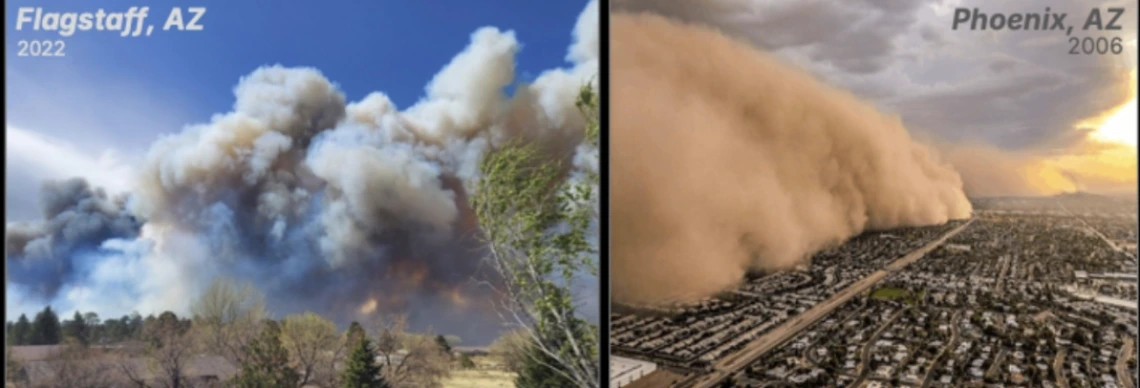
Wildfire smoke in Flagstaff, AZ in April of 2022 (left). Dust storm in Phoenix in 2006 (right).
Image source: pbs.org, redrocknews.com
The following article was written by McKenna Manzo and published by the UA College of Science. You can read the original article here.
¤
Congratulations to HAS Professor Ave Arellano Jr., his UA research team, and three peer institutions who have received a $4.8 million grant from the National Science Foundation (NSF) to fund research on redesigning how pollution and wildfire smoke are tracked, forecasted and communicated!
Led by the University of Arizona, the four institutions — the U of A, the NSF National Center for Atmospheric Research, the University at Albany, and the University of Iowa — are partnering to modernize aging air quality models into a more flexible, community-driven system designed to better protect people from rising air pollution.
For decades, air quality forecasting in the U.S. has relied on models like the Community Multiscale Air Quality Modeling System (CMAQ), used by the Environmental Protection Agency, and the Weather Research Forecasting with Chemistry (WRF-Chem), which links weather and atmospheric chemistry. These tools have been essential for predicting pollution levels and understanding health risks. But WRF-Chem is now being phased out, and the nation’s next-generation global and regional weather model, the Model for Prediction Across Scales (MPAS), still lacks a modern air quality component. This creates a critical gap at a time when extreme heat, wildfire smoke, particulate pollution, and ozone exceedances are becoming more frequent and more severe across the country.

“It’s very hard for us to improve these older legacy models,” Arellano said. “They’ve accumulated so many additions from the community over the years that the computing side isn’t keeping up with the science. We needed a new way.”
The “new way” comes from game development ideas. In the same way game engines use top-down modular design, built around libraries for graphics, physics, character movement – the team will adopt the same strategy for atmospheric chemistry. The team will develop modular libraries that define how pollutants move, settle, react, or get introduced into the air, allowing scientists to plug in or modify components without rewriting the whole model. Students and researchers will be able to describe what they want to model using a simple high-level script, which software engineers will translate into a working model. The design aims to transform air quality research by making it far more accessible.
“It lowers the mental and skillset barrier,” Arellano said. “Students won’t need to be expert programmers to explore new scientific questions.”
The engine’s core will be designed and built by atmospheric chemists and software engineers at the National Center for Atmospheric Research (NCAR), University of Arizona, University of Albany, and University of Iowa will lead the scientific direction and recruit students. Undergraduate computer science majors will help construct the engine’s components, while atmospheric science students define the modeling needs. Every year, students will travel to NCAR to collaborate in person.
“There’s a language barrier between computer scientists and atmospheric scientists,” Arellano said. “This project forces us to learn how to communicate with each other and that’s good for the next generation.”
Arellano hopes the new cyber infrastructure will help scientists better understand the “human fingerprints” in the atmosphere. These fingerprints come from pollutants generated by combustion, dust, wildfire smoke, and other human activities, each influenced by weather, climate, and with implications for health and agriculture. For the Southwest, where wildfire season now stretches across much of the year, a modernized system could dramatically improve forecasting and risk assessments.
“Our whole goal is to build something flexible, something future-proof,” Arellano said. “This is the new wave of air-quality modeling. And it starts with giving students the tools to make their own discoveries.”
Congratulations, Ave!
To learn more about Ave's research, click here.